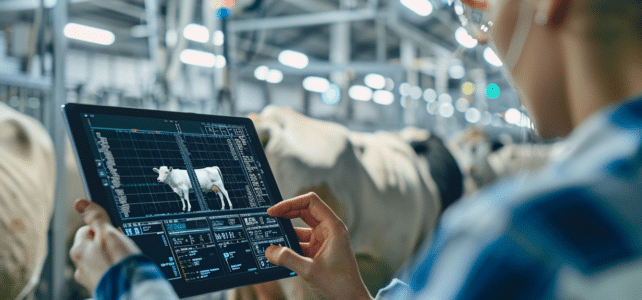
The digital age has revolutionized agriculture, bringing innovative solutions for dairies. Owners and managers of these operations face significant challenges such as increasing production while maintaining high quality, improving animal welfare, and reducing environmental impacts. The implementation of modern digital tools offers a valuable opportunity to optimize daily operations. From advanced herd management software to smart sensors and robotics, technology enables monitoring of livestock health, automating processes, and making informed decisions based on accurate data.
Digital Tools for Operational Efficiency in Dairies
Optimizing dairy management is no longer an option but a necessity in an increasingly competitive market. The ERP solution Infor CloudSuite Food & Beverage, used by Cremo, perfectly illustrates this transformation. As the second largest milk processor in Switzerland, Cremo has modernized its IT infrastructure, thereby improving the quality and optimization of its processes. This tool, leveraging the cloud services of Amazon Web Services (AWS), provides seamless data integration and increased responsiveness to market demands.
The quality of dairy products closely depends on the accuracy and consistency of production processes. Rockwell Automation, with its FactoryTalk Analytics Pavilion8 platform, develops industrial automation solutions that allow dairies to increase their production capacity while reducing production costs. These advanced technologies offer precise control of humidity and temperature, key factors in ensuring the preservation and quality of milk.
Real-time data collection through sensors and predictive analytics becomes a strategic decision-making vector for dairy managers. The platform Infolabo, which aggregates and analyzes data from various sources, is a striking example of this potential. It provides a comprehensive view of production performance, anticipating maintenance and optimization needs in the production chain.
Integrated management systems offer a holistic solution, ranging from traceability of the finished product to resource management. They not only allow tracking of the product at every stage of its transformation but also monitor the energy efficiency of equipment, inventory and order management, and ensure regulatory compliance. The adoption of these technologies by companies like Cremo highlights their essential role in the success and sustainability of the modern dairy industry.

Impact of Digital Technologies on Dairy Product Quality and Traceability
The quality of dairy products and their traceability represent major challenges for the dairy industry. With the integration of Artificial Intelligence (AI), these aspects are experiencing an unprecedented revolution. AI, by optimizing crop management and livestock breeding, enables milk producers to maximize the quality of their production while ensuring more precise and proactive resource management. This is a giant leap towards enhanced food security, in a world where consumers demand total transparency regarding the origin and treatment of food products.
Arla Foods, as a partner of Starbucks for milk-based coffee production, is committed to the traceability of its supply chain, thus responding to consumer preferences for products with clearly identified origins. Traceability is not only a promise of quality but also a commitment to responsible and sustainable farming and production practices. Careful monitoring at every stage of production up to final delivery is now a reality thanks to advanced digital tools.
Naturmælk, an organic dairy company, also illustrates this trend by closely collaborating with chefs and baristas to develop dairy products that meet the strict demands of Scandinavian cuisine. These products, derived from organic farming, are the result of refined and environmentally respectful management, made possible by the use of advanced digital tools that monitor and optimize every aspect of production.
The role of these technologies in the transformation of the dairy industry is evident. They do not merely track the product but also integrate societal expectations regarding sustainable development and animal welfare. Their adoption by companies like Arla Foods and Naturmælk demonstrates their ability to raise quality standards and provide complete traceability, from farm to table.